Table of Contents
- Why Master Technician Hiring Matters
- Core Automotive Technician Interview Questions
- Master-Level Competency Questions
- Automotive Technician Interview Scorecard
- Automotive Technician Practical Test
- Automotive Technician Hiring Best Practices
- Common Mistakes to Avoid in Master Technician Interviews
- Frequently Asked Questions
Last Updated: October 14, 2026
Why Master Technician Hiring Matters
A skilled master technician doesn’t just fix cars, they diagnose complex problems, mentor junior staff, and build customer trust.
At AUTOjobs.com, Inc., we work with dealerships and independent repair shops nationwide.
This guide covers the questions that separate master-level technicians from those who’ve simply accumulated years on the job, plus structured frameworks, practical scenarios, and a scoring rubric.
Master technicians are rare. The questions you ask determine whether you find one or hire someone who looks good on paper but struggles with complex diagnostics and customer communication.
Core Automotive Technician Interview Questions
Start with foundational questions that reveal a candidate’s background, motivation, and technical grounding.
Technical Background and Certifications
Ask about formal training and credentials early. ASE certifications matter, but how candidates talk about them tells you more than the certificate itself.
Key questions to ask:
- “Walk me through your automotive training, formal education, apprenticeships, on-the-job learning. What was most valuable?”
- “Which ASE certifications do you hold, and why did you prioritize those first?”
- “How do you stay current with manufacturer technical bulletins and recalls?”
- “Tell me about a time you discovered you were wrong about a diagnosis. What happened?”
- “What’s the most complex repair you’ve performed in the last year?”
The answers reveal whether they’re committed to continuous learning or coasting. A master technician can articulate why certifications matter for their specialty and admits mistakes, a sign of confidence, not weakness.
Diagnostic Approach and Problem-Solving
This separates competent technicians from skilled diagnosticians. Ask about their systematic approach to troubleshooting.
Key questions to ask:
- “Walk me through your process when a customer comes in with an intermittent electrical issue.”
- “How do you decide whether to use a scan tool first or perform visual inspection?”
- “Tell me about a repair that took longer than expected. How did you handle it?”
- “What diagnostic equipment do you consider essential, and why?”
- “How do you communicate technical findings to customers who don’t understand automotive systems?”
Listen for systematic thinking: master technicians gather data, form hypotheses, and test methodically. They also understand that communicating findings clearly affects whether customers approve repairs and return.
Vehicle Systems and Repair Experience
Dig into their hands-on experience with specific systems, breadth and depth both matter.
Key questions to ask:
- “What vehicle systems do you feel most confident diagnosing and repairing?”
- “Tell me about your experience with hybrid or electric vehicle diagnostics.”
- “Have you performed transmission work? Describe the most challenging transmission repair you’ve done.”
- “What’s your experience with engine diagnostics, compression testing, fuel system diagnosis, ignition systems?”
- “How comfortable are you with modern emissions systems and OBD-II diagnostics?”
Master technicians have depth in several systems and recognize the limits of their knowledge, showing willingness to learn. EV experience is increasingly important, even without it, their answer reveals whether they’re staying ahead of industry shifts.
Master-Level Competency Questions
These questions assess advanced diagnostic capability, leadership potential, and the ability to handle your shop’s most complex challenges.
Advanced Diagnostics and Modern Vehicle Technology
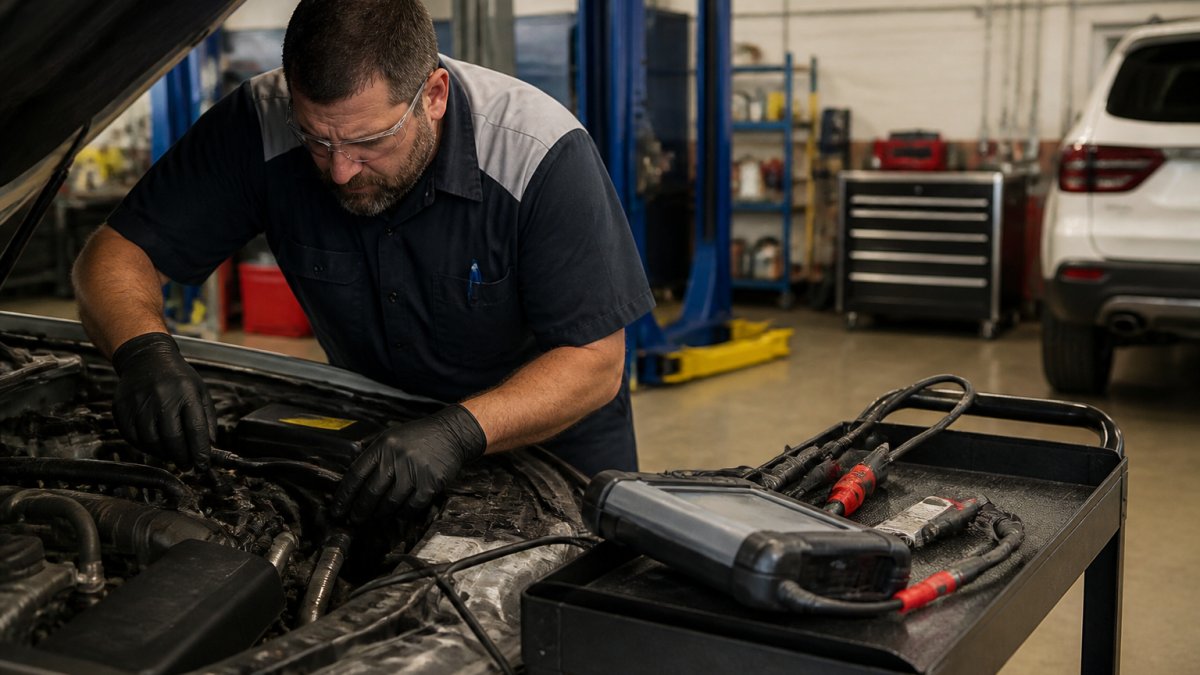
Modern vehicles are rolling computers. Ask how candidates handle diagnostic challenges requiring deep technical knowledge.
Key questions to ask:
- “Walk me through how you’d diagnose a vehicle with multiple fault codes that seem unrelated. How do you determine the root cause?”
- “Describe your experience with module programming and reflashing. When is it necessary, and what are the risks?”
- “A customer’s vehicle has an intermittent fault that clears after a few minutes. How do you approach this?”
- “Tell me about your experience with advanced scan tools and data stream analysis. Which tools do you prefer and why?”
- “How do you handle a repair where the manufacturer’s technical bulletin contradicts what you’re seeing in the data?”
Look for candidates who understand that modern diagnostics require patience, systematic data collection, and willingness to consult multiple resources.
Leadership, Mentoring, and Shop Impact
Master technicians influence your entire operation. Ask how they develop others and contribute beyond their own bay.
Key questions to ask:
- “Tell me about a junior technician you’ve mentored. What did you teach them, and how did they improve?”
- “How do you handle it when a less experienced technician makes a mistake on a vehicle you’re responsible for?”
- “Describe a time you identified a process or procedure in your shop that needed improvement. What did you do?”
- “How do you balance your own work volume with helping others?”
- “What does a strong shop culture look like to you, and how do you contribute to it?”
Master technicians lift the entire team, sharing knowledge and taking ownership of quality across the shop. Their answers reveal whether they see themselves as individual contributors or leaders who make others better.
Ethics, Documentation, and Customer Authorization
This is where character matters most. Ask how they handle the gray areas that test integrity.
Key questions to ask:
- “A customer authorizes a specific repair, but during diagnosis you discover a related issue that needs attention. How do you handle this?”
- “Walk me through how you document your diagnostic steps and findings on a work order.”
- “Tell me about a time you recommended against a repair because you didn’t think it would solve the customer’s problem.”
- “How do you handle warranty work differently than customer-paid work?”
- “A customer questions your diagnosis. How do you respond?”
Master technicians prioritize customer trust over quick sales, document thoroughly so others can follow their logic, and explain their reasoning clearly. These answers reveal whether someone will protect your shop’s reputation or cut corners for speed. Reliable documentation and consistent communication also rely on integrated technician scheduling software to ensure that every repair order remains transparent and accountable throughout the entire service process.
Automotive Technician Interview Scorecard
A scorecard forces you to evaluate candidates against the same criteria, reducing bias and improving hiring quality.
Scoring Framework and Evaluation Criteria
Score each area from 1-5, with clear definitions for what each score means.
| Competency | Score 1 (Weak) | Score 3 (Acceptable) | Score 5 (Master-Level) |
|---|---|---|---|
| Technical Depth | Limited system knowledge, few certifications | Solid foundation, relevant certifications current | Deep expertise across multiple systems, continuous learning |
| Diagnostic Approach | Guesses or relies on parts replacement | Systematic troubleshooting, uses scan tools | Root-cause analysis, advanced diagnostics, data interpretation |
| Communication | Difficult to understand, poor listening | Clear explanations, adequate customer interaction | Articulate technical findings, builds customer confidence |
| Problem-Solving | Struggles with complex issues | Handles standard repairs effectively | Manages intermittent faults, complex diagnostics, novel problems |
| Leadership Potential | Works in isolation, resists feedback | Capable individual contributor | Mentors others, improves processes, elevates team |
| Work Quality | Frequent comebacks, warranty issues | Meets standards, acceptable first-time fix rate | Consistently high quality, minimal comebacks, attention to detail |
| Customer Focus | Dismissive of customer concerns | Adequate customer service | Prioritizes customer trust, explains thoroughly, builds loyalty |
Rating Technical Depth and Diagnostic Capability
Technical depth is your most important hiring criterion. Master technicians demonstrate it through specific examples and by articulating why they approach problems systematically.
When scoring technical depth, listen for:
- Specific certifications and why they pursued them
- Examples of complex repairs they’ve completed
- Knowledge of vehicle systems beyond their primary specialty
A candidate scoring 5 can discuss module programming, data stream analysis, and root-cause diagnosis, referencing specific challenges they’ve solved.
Post Master Automotive Technician Jobs →
A candidate scoring 3 has solid foundations and current certifications but may lack depth in advanced diagnostics or emerging technologies, struggling with intermittent faults or complex multi-system issues.
Automotive Technician Practical Test
Paper interviews reveal what candidates say they can do; practical assessments show what they actually can do. Consider adding a hands-on component.
Assessment Scenarios and Real-World Tasks
Design practical tests that mirror real work your shop performs, simple scenarios reveal diagnostic thinking.
Scenario 1: Intermittent Electrical Fault
Present a vehicle with an intermittent no-start condition that appears random.
Scenario 2: Multiple Fault Codes
Provide a vehicle with several unrelated fault codes.
Scenario 4: Customer Communication
Describe a customer complaint and ask them to explain how they’d communicate their findings.
Evaluating First-Time Fix Rate and Quality Control
First-time fix rate reflects diagnostic accuracy, attention to detail, and commitment to quality over speed.
Ask candidates about their personal first-time fix rate. A master technician can cite this number and discuss what drives it, understanding that comebacks cost money, damage relationships, and waste time.
Also ask about quality control: do they double-check work, test repairs thoroughly before returning the vehicle, and follow up to ensure the problem is solved?
Automotive Technician Hiring Best Practices
Structured hiring processes produce better results. Unscripted interviews favor candidates who interview well, not necessarily those who work best.
Structured Interview Process and Consistency
Use the same questions with every candidate to compare apples to apples.
Create a question bank organized by competency, asking each candidate the same core questions in the same order.
Document responses in real-time rather than relying on memory.
Include multiple interviewers when possible, a service manager, lead technician, and HR representative, together or separately. Different perspectives catch things you might miss alone.
Reducing Hiring Time and Comeback Rates
Faster hiring doesn’t mean lower quality, it means removing inefficiency.
Post your positions on platforms that reach qualified candidates. AUTOjobs.com, Inc. connects you with automotive professionals actively seeking roles in your area.
Set clear timelines and follow through. Top candidates have options, delays cost you the best people.
Make hiring decisions quickly once you’ve identified your top candidate. Master technicians are in demand.
Common Mistakes to Avoid in Master Technician Interviews
Hiring the wrong person is expensive. Avoid these pitfalls.
Mistake 3: Skipping the practical assessment. Some candidates interview well but struggle with actual diagnostic work.
Mistake 5: Ignoring cultural fit. A master technician who won’t collaborate or mentor damages your shop’s culture.
Mistake 6: Moving too slowly. Every day a position sits unfilled costs revenue and overloads your team.
Hiring the right master technician requires asking the right questions and evaluating responses against clear criteria.
Frequently Asked Questions
What questions should I ask when interviewing a master technician?
Focus on diagnostic methodology, advanced vehicle systems knowledge, and shop leadership impact. Ask how they approach complex electrical or transmission issues, how they mentor junior technicians, and how they balance productivity with quality. Master technician interview questions should probe real-world decision-making: ‘Walk me through a time you diagnosed a recurring issue that stumped other technicians.’ Include questions about ASE Master Certification, experience with modern diagnostic equipment, and their approach to warranty repairs and recalls.
How do you assess a master technician’s diagnostic skills during an interview?
Use scenario-based questions tied to actual repair work: ‘A customer reports intermittent electrical gremlins. What’s your diagnostic process?’ Listen for root-cause thinking, not just symptom-chasing. Ask about scan tool proficiency, how they read technical service bulletins, and experience troubleshooting complex vehicle systems. Include a practical test if possible: present a real repair order or diagnostic challenge from your shop and observe their approach to problem-solving and use of technical information.
What should a master technician interview include?
A complete master technician interview combines technical depth, leadership capability, and shop-culture fit. Include sections on repair experience across vehicle systems (engine, transmission, brake systems, electrical), ASE certifications and ongoing training, diagnostic approach on complex repairs, mentoring and onboarding experience, quality control and first-time fix rate, and customer communication skills. Allocate time for the candidate to ask about shop performance metrics, service department income structure, and your shop’s approach to preventive maintenance and recalls.
How can I use an automotive technician interview scorecard to ensure fair evaluation?
An automotive technician interview scorecard standardizes assessment across all candidates by defining clear criteria and point values for each competency: technical knowledge (25 points), diagnostic skills (25 points), leadership and mentoring (20 points), communication (15 points), and cultural fit (15 points). Rate each answer on a 1-5 scale within its category. This removes bias and creates a consistent hiring process. Document responses and scores for every candidate so you can compare objectively and justify your hiring decision to your team.
What practical test can you use when hiring an automotive technician?
An automotive technician practical test assesses real competency under observation. Present a vehicle with a known issue (electrical fault, drivability problem, or brake concern) and ask the candidate to diagnose it using your shop’s tools and technical information. Observe their scan tool use, logical troubleshooting sequence, and safety procedures. Alternatively, review a complex repair order and ask them to walk through their diagnostic and repair plan. Time the assessment (typically 30-45 minutes) and score based on accuracy, efficiency, safety awareness, and communication of findings.
