Last Updated: November 2, 2026
Quick Summary
The best ways to hire diesel mechanics start with relevance: post openings on an automotive-only job board so your listing reaches technicians who already work on diesel engines, then filter with a job description that names the actual work and equipment. Add referrals, school pipelines, and a scored skills assessment before the interview to confirm hands-on ability.
- Post on an automotive-only platform to cut unqualified and ghost applicants before resume review.
- Name the actual equipment, experience level, and certifications in the job description.
- Tie referral rewards to a hire surviving the first 90 days to keep incentives honest.
- Run a 45 to 60 minute scored assessment as a gate before the formal interview.
- Assign a mentor for the first month and hold check-ins at 30, 60, and 90 days.
Table of Contents
- Why the Best Ways to Hire Diesel Mechanics Start With Relevance
- 1. Post Where Diesel Mechanics Actually Search
- 2. Write a Diesel Mechanic Job Description That Filters for Skill
- 3. Build Referral Rewards and School Pipelines
- 4. Use a Diesel Mechanic Skills Assessment Before the Interview
- 5. Ask Diesel Technician Interview Questions That Reveal Real Experience
- 6. Get Diesel Mechanic Onboarding and Training Right in the First 90 Days
- 7. Retain the Technicians You Hire
- Frequently Asked Questions
Why the Best Ways to Hire Diesel Mechanics Start With Relevance
The best ways to hire diesel mechanics share one trait: they put your opening in front of people who already work on diesel engines.
Most shops treat hiring as a numbers game and then wonder why the funnel clogs. It clogs because the source was wrong from the start. Fix the source, and the rest of the process gets easier.
1. Post Where Diesel Mechanics Actually Search
Post on a platform built for automotive careers, not a general job site that serves every industry at once. Browse the Diesel Technician job category to see where those postings live. That single change removes most of the noise before you review a single resume.
The Problem With General Job Boards
General job boards sell reach. Reach is not your problem. Your problem is a shop helper with no diesel experience applying to a technician opening because a keyword matched. Mass-application sites also attract ghost applicants and candidates from outside the trade entirely. You end up screening resumes for hours to find one person who knows a diesel particulate filter from a fuel injector.
What an Automotive-Only Audience Changes
An automotive-only board means every job seeker is there for a career in this industry. AUTOjobs.com has been independently owned and industry-driven since 1995, with industry-specific categories and a curated resume database instead of artificial applicant volume. Fewer resumes, better ones.
2. Write a Diesel Mechanic Job Description That Filters for Skill
A strong diesel mechanic job description names the actual work, the actual equipment, and the actual experience level. Vague postings attract vague applicants.
Spell out what the technician will touch: diesel engine diagnostics, aftertreatment systems, electrical and hydraulic repair, preventive maintenance schedules. This Diesel Mechanic listing in Champaign, IL frames municipal fleet duties and qualifications concretely. A real posting like this Diesel Technician role in Harrison, OH shows the language and requirements in practice.
Watch out: listing every possible task turns a technician role into a job nobody qualified wants. Keep the must-haves short.
3. Build Referral Rewards and School Pipelines
Referrals and school partnerships produce technicians who arrive with context. Both take time to build, and both pay off repeatedly.
Employee Referrals: The Highest-Trust Source
Your current techs already know who is good. A referral reward tied to a hire surviving the first 90 days keeps the incentive honest. Ask your best diesel technician who they would want on the next bay over, and pay for that introduction. A Fleet Mechanic role in East Syracuse, NY shows the kind of position referrals and school pipelines feed into.
Local Schools and Training Programs
Community colleges and technical education programs turn out recent graduates every term. Build a relationship with the instructor, not just the placement office. Offer a tour, host a shop helper or internship slot, and stay in touch.
4. Use a Diesel Mechanic Skills Assessment Before the Interview
A diesel mechanic skills assessment is a short, practical test of hands-on ability given before the formal interview. It saves everyone time by screening out candidates who interview well but cannot diagnose. The mistake most shops make is treating it as a formality.
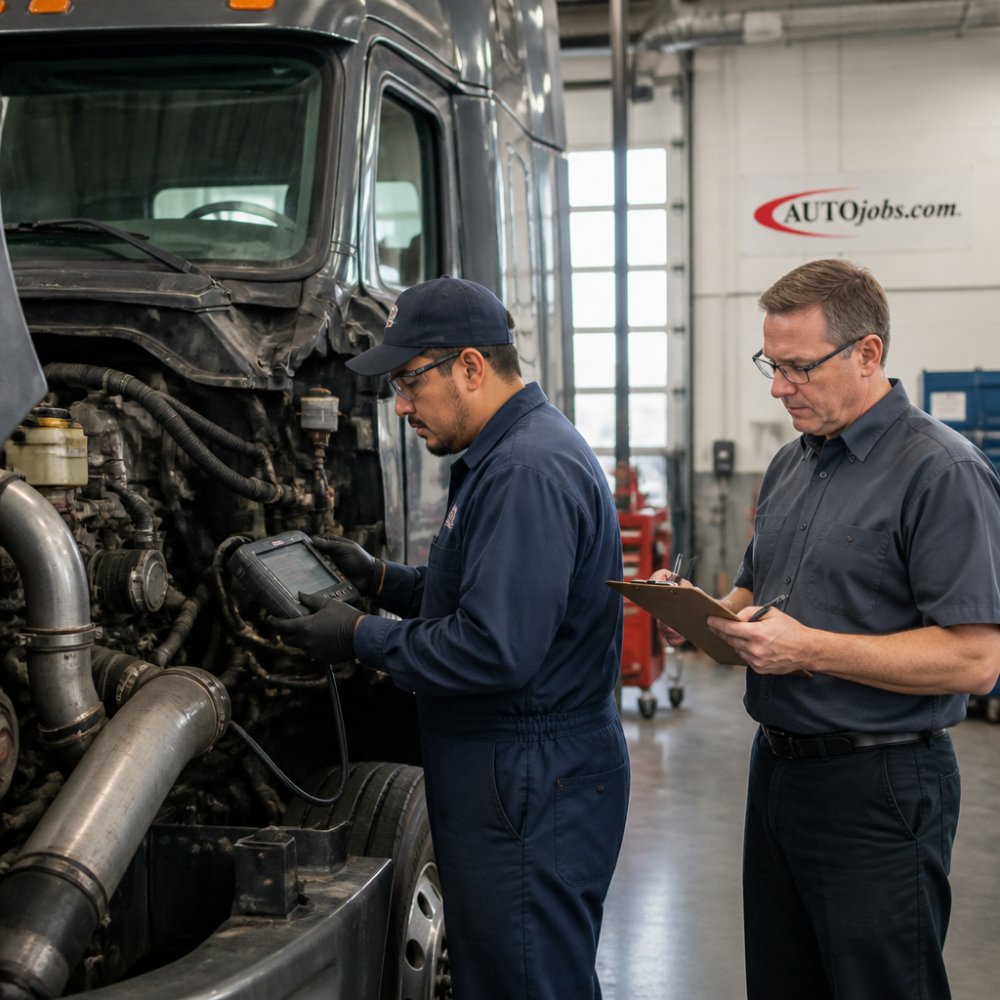
[IMAGE: A diesel technician in work clothes diagnosing a heavy-duty truck engine with a laptop and diagnostic tool in a clean, well-lit service bay, a service manager observing and taking notes on a clipboard | section:4.
Build the Assessment Around Your Actual Shop Work
Keep it job-relevant and short, 45 to 60 minutes total. A fault-code scenario, a component identification exercise, a short diagnostic walkthrough, and one hands-on task cover the range you need. Score every element against a simple rubric so two managers grading the same candidate reach the same conclusion.
| Assessment Element | What It Reveals | Time | Scoring Anchor |
|---|---|---|---|
| Fault-code scenario | Diagnostic reasoning | 15 min | 0 = no path, 1 = partial path, 2 = correct path with reasoning |
| Component identification | Familiarity with diesel systems | 10 min | Count correct out of 10 |
| Safety and procedure questions | Work ethic and reliability | 10 min | Pass/fail on lockout, PPE, and lift-point answers |
| Hands-on task | Mechanical skills in practice | 20 min | 0-3 scale on technique, tool use, and cleanup |
Set a minimum score before you start interviewing. A common pattern is to require a passing mark on the safety questions and at least 60 percent on the diagnostic and hands-on elements.
Keep It Legal and Consistent
The assessment has to measure the job, not the person. Test only skills that appear in your job description, ask every candidate the same questions, and keep the same scoring sheet on file for each one. That consistency is what protects you if a rejected candidate ever questions the decision. It also gives you a clean record of why a hire was made.
Feed the Results Into the Interview
The assessment is not a standalone test; it sets up the interview. If a candidate struggled on the aftertreatment fault-code scenario, the interview should probe that exact area. If they aced the hands-on task but stumbled on safety, ask them to walk through a lockout procedure out loud. Pairing the two gives you a clear, evidence-based picture before you make an offer, and it stops the conversation from drifting into personality impressions.
Score the assessment before the interview, not after. Grading first keeps the interview focused on the gaps the test exposed instead of re-covering ground the candidate already proved.
5. Ask Diesel Technician Interview Questions That Reveal Real Experience
Good diesel technician interview questions ask for stories, not definitions. Ask the candidate to walk you through the last difficult diagnostic they solved. Ask how they handle a repair that comes back.
Listen for specifics: tools used, steps taken, how they documented the work. A technician with real experience answers in detail. One who has only read about it stays general. Pair these questions with the skills assessment and you get a clear picture before you make an offer.
6. Get Diesel Mechanic Onboarding and Training Right in the First 90 Days
Diesel mechanic onboarding and training decide whether a good hire stays. The first 90 days set the pattern.
Assign a mentor for the first month. Pair hands-on training with your shop’s actual procedures, not a generic video library. Schedule a check-in at 30, 60, and 90 days, and ask directly what is working and what is not. New technicians leave when they feel dropped, not when the pay is wrong.
7. Retain the Technicians You Hire
Retention starts before the offer and continues past the first 90 days. Most shops lose technicians for reasons they could have measured and fixed: pay that drifted below the local market, a career path that stalled at entry level, or no one tracking whether new hires actually stayed. Treat retention as a set of numbers you review, not a feeling you hope for.
Pay That Holds Up Against the Local Market
Review hourly wage and overtime against local pay ranges at least once a year, and again whenever you lose a technician you wanted to keep. Diesel technician pay varies by market, shop type, and specialization. Pull local ranges from job postings in your area, public wage data, and your own offer history. If your posted range has not moved in two years, it is almost certainly behind.
A Career Path the Technician Can See
Map out advancement in plain terms and share it during onboarding, not after the first year. A workable structure looks like this:
- Entry level / shop helper, preventive maintenance, tire and brake work, learning the shop’s procedures.
- Technician, engine, electrical, and hydraulic repair under supervision.
- Diagnostic specialist, fault-code diagnosis, aftertreatment systems, complex electrical work.
- Lead or shop foreman, mentoring, work assignment, quality control.
Fund certifications as part of skill development, and tie each certification to a step on that path. A technician who can see the next rung is far less likely to look for it at another shop.
Total Rewards, Not Just Hourly Wage
Hourly wage is the number candidates compare, but it is not the whole offer. Tools, boot and uniform allowances, paid training time, health benefits, retirement match, shift differentials, and guaranteed overtime all change the real value of a job. When you make an offer, put the total package in writing so the candidate can compare it honestly against a competing offer.
Measure the Numbers That Predict Turnover
Track a small set of hiring and retention KPIs every quarter. You do not need a dashboard, a simple spreadsheet works.
| KPI | What It Tells You |
|---|---|
| Time-to-fill | How long an opening stays empty and how much overtime it costs the rest of the shop |
| Offer acceptance rate | Whether your pay and package are competitive in your market |
| 90-day retention | Whether onboarding and mentoring are working |
| First-year retention | Whether the career path and pay hold up past the honeymoon |
| Training progression | Whether new hires are actually moving through certifications and skill levels |
If time-to-fill climbs while offer acceptance falls, the problem is upstream in sourcing or pay. If acceptance is strong but 90-day retention slips, the problem is onboarding. If first-year retention drops, look at career path and pay reviews. Each number points to a different fix, which is why tracking them beats guessing.
Retention is cheaper than recruiting. Every technician you keep is a hire you do not have to make, and the KPIs above tell you where to spend your attention before a resignation letter forces the issue.
Frequently Asked Questions
Where can employers find qualified diesel mechanics?
Start with sources where the audience is already automotive: an automotive-only job board, employee referrals, and local diesel training programs. General job boards produce volume, but much of it comes from applicants outside the trade. The best ways to hire diesel mechanics all share one trait: they put your opening in front of people with hands-on diesel experience, so your time goes into reviewing qualified candidates instead of filtering out noise.
Should employers hire entry-level diesel mechanics and train them?
Yes, when the shop has the mentoring capacity to support it. Hiring recent graduates and shop helpers gives you technicians you can shape around your own diagnostic processes and equipment. Pair each new hire with an experienced mentor for the first 90 days, set clear skill milestones, and review progress weekly. The trade-off is time: an entry-level hire needs structured onboarding and training before they turn wrenches independently, so plan the workload accordingly.
How can employers assess a diesel mechanic’s hands-on skills?
Use a practical skills assessment in addition to the interview. A short diagnostic scenario on a real engine, a review of past repair work, and questions about how the candidate traces a fault through related systems will show more than a resume. Keep the assessment consistent across candidates so you can compare results fairly, and document what each one did well and where they struggled.
How can shops retain diesel technicians after hiring?
Retention starts before day one. Give new hires a realistic preview of the job, including shift expectations and overtime, so there are no surprises. Then invest in onboarding and training, pay competitively for the local market, and lay out a career path with certifications and skill development. Technicians who see advancement and steady investment in their skills are far less likely to move on.
Hiring diesel mechanics is a sourcing problem before it is anything else. If your shop is tired of screening unqualified applicants, AUTOjobs.com puts your opening in front of an automotive-only audience, with a curated resume database, industry-specific job categories, and targeted visibility for every posting. Get started with AUTOjobs.com and fill your next technician opening with candidates who already know the trade.

