Last Updated: October 23, 2026
Quick Summary
When comparing recruitment agency vs job board, the core difference is clear: a recruitment agency actively sources and vets candidates on your behalf, while a job board posts your opening and waits for applicants. Agencies excel at hard-to-fill and leadership roles; job boards work best when you have screening bandwidth and want control over sourcing.
- Agencies take ownership of sourcing, screening, and candidate presentation; job boards are self-service platforms where you review applicants.
- Cost per qualified hire matters more than cost per posting or placement fee when measuring channel effectiveness.
- Automotive-specific job boards eliminate unqualified applicants by reaching only candidates already in the industry, unlike general boards.
- Hard-to-fill roles like master technicians and service directors favor agencies; service advisors and parts staff favor job boards.
- A blended strategy using both channels simultaneously hedges risk and handles specialized searches while building an ongoing pipeline.
Table of Contents
- Recruitment Agency vs Job Board: Core Differences
- How to Hire Automotive Technicians: Staffing Agency Approach
- Job Board Applicant Quality: What You’re Actually Getting
- Automotive Recruiting Tools: What Each Channel Offers
- Speed, Cost, and Control: Direct Comparison
- Using Both Channels Together: A Blended Strategy
- Choosing the Right Channel for Your Shop
- Conclusion
- Frequently Asked Questions
Recruitment Agency vs Job Board: Core Differences
At AUTOjobs.com, we’ve watched shop owners and dealership managers wrestle with this choice.
Here’s what separates them in practice:
Recruitment agencies take ownership of the search. They maintain a candidate roster, actively reach out to prospects, screen for qualifications, and present vetted candidates. You’re paying for their expertise and network.
Job boards are passive by design. You post an opening, candidates apply, and you review submissions. The platform provides distribution and sometimes resume-filtering tools, but you own sourcing and evaluation.
The cost structure reflects this difference. Agencies typically work on contingency or retainer; job boards charge a fee for posting or subscription.
How to Hire Automotive Technicians: Staffing Agency Approach
What a staffing agency does for automotive hiring
A staffing agency becomes an extension of your hiring team, actively searching for people who fit your needs rather than just posting the job.
Here’s the workflow: You describe the role, culture, and technical requirements. The agency taps its network, searches industry databases, and sometimes cold-contacts prospects.
For automotive roles, this matters.
Agencies also handle logistics: scheduling interviews, negotiating offers, managing counteroffers, and sometimes onboarding paperwork.
When a staffing agency makes sense
Staffing agencies excel in specific scenarios:
Hard-to-fill roles. A master technician, service manager, or EV-certified tech isn’t browsing Indeed passively. An agency with automotive connections can find them.
Volume hiring. Opening a new service department or expanding quickly? An agency sources multiple candidates in parallel while you run operations.
Executive or leadership roles. Finding a fixed operations director or service director isn’t a job-posting exercise. It requires networking and industry knowledge. Agencies excel here.
The Trade-Off: Recruiting agencies typically charge higher fees and can add time to the hiring process while limiting an employer’s direct involvement in identifying potential candidates. Rather than giving the company access to the full pool of applicants, recruiters generally screen candidates based on their own interpretation of the employer’s requirements and present only those they believe are the best fit. The problem is that a recruiter’s assessment doesn’t always reflect what a hiring manager might recognize during a direct conversation or interview. As a result, potentially qualified candidates may never be presented to the employer, including individuals who could turn out to be an excellent fit for the position. Ultimately, the company is relying on someone else’s judgment to decide which candidates deserve consideration, potentially overlooking valuable talent before the hiring process even begins.
Job Board Applicant Quality: What You’re Actually Getting
Why general job boards attract unqualified applicants
General employment websites cast a wide net, advertising positions across virtually every industry. When an automotive dealership or repair shop posts a Technician opening alongside jobs in retail, accounting, hospitality, and dozens of unrelated fields, the result is often a large pool of applicants with no automotive experience.
Some candidates automatically apply for positions simply because a keyword such as “Technician” matches their job search, even when they have no automotive repair experience. General employment websites may also use automated job-matching systems to recommend candidates or generate application activity that creates the impression of strong interest without necessarily producing qualified applicants. These low-quality or poorly matched submissions are sometimes referred to as “ghost applicants.” Adding to the challenge, AI-generated resumes can be tailored to match job descriptions and screening keywords, making candidates appear more qualified on paper than their actual skills and experience may justify.
Receiving 50 applications in 48 hours might sound impressive, but application volume doesn’t necessarily translate into qualified candidates. When hiring managers spend hours reviewing resumes from individuals who lack the required automotive skills and experience, valuable time is lost separating relevant applicants from unrelated submissions.
The goal isn’t to attract the most applications. It’s to attract the right applicants.
Automotive-specific job boards and candidate vetting
This is where the distinction matters most. An automotive-only job board, one where every job seeker is there specifically for a career in automotive, changes the equation entirely.
On a platform built for automotive professionals, a technician applicant chose to be there because they want automotive work. Explore regional hiring patterns and job market trends for diesel technicians to understand how geographic and compensation factors shape your applicant pool.
Automotive-specific boards also use industry-focused resume tools that capture ASE, EPA, and manufacturer-specific certifications, plus hands-on experience and technical specialties, eliminating irrelevant candidates before you see them.
Automotive Recruiting Tools: What Each Channel Offers
Staffing agencies provide candidate screening, industry connections, and time management. Your role is narrower: review pre-vetted candidates and decide.
General job boards provide reach and volume. They’re self-service: you post, candidates apply, you screen.
Automotive job boards sit between these two. They provide targeted reach, resume tools designed for automotive hiring, and candidate access.
Match the tool to your workflow. With HR bandwidth, a job board gives you control at lower cost.
Speed, Cost, and Control: Direct Comparison
Most comparisons of agencies and job boards stop at “agencies are faster and more expensive.” What actually decides the outcome is the cost per qualified hire, the time to a shortlist you can interview, and how much screening labor lands on your desk.
The cost mechanics behind each channel
An agency’s fee is usually tied to the hire itself, contingency arrangements pay out on placement, retainer arrangements bill in stages, and contract placements bill on an hourly markup.
A job board’s cost is tied to access, not outcome. You pay for a posting or subscription window, and the cost is the same whether you get one qualified applicant or forty.
The number that matters is cost per qualified hire, not cost per posting or cost per placement.
Time to shortlist versus time to hire
Agency timelines are usually quoted as time to placement, which bundles sourcing, screening, interviews, and negotiation into one number.
A job board’s clock starts when the posting goes live and depends on whether the right people see it.
Neither channel controls the last mile. Interview scheduling, offer negotiation, counteroffers, and notice periods are yours to manage regardless of how the candidate arrived.
Who owns the screening burden
With an agency, screening is delegated. You review a short list and make the call. That’s valuable when your bench is thin or the role requires credentials you can’t easily verify.
With a job board, screening is yours. You see every applicant, which is more work but also more control, you can spot the candidate with the right hands-on experience but an unconventional resume, or the service advisor whose communication style fits your drive.
A practical scorecard
Measure any channel on the same five numbers over a rolling quarter:
- Time to shortlist, days from posting or engagement to the first three interviewable candidates.
- Interview-to-offer ratio, how many interviews it takes to reach an offer you’re confident in.
- Offer acceptance rate, a low rate signals a compensation, process, or candidate-quality problem, not a channel problem.
Run the scorecard per role type, not per channel overall. A channel that wins for service advisors may lose badly for master technicians, and the blended strategy only works if you know which is which.
Here’s how agencies and job boards stack up across the metrics that actually drive hiring outcomes.
| Metric | Recruitment Agency | Job Board |
|---|---|---|
| Cost structure | Contingency, retainer, or hourly markup | Per-posting or subscription fee |
| Screening burden | Delegated to agency | Owned by employer |
| Time to shortlist | Fast, network-based sourcing | Depends on applicant pool relevance |
| Control over sourcing | Limited; trust agency’s definition | Full; you review every applicant |
| Best for | Hard-to-fill, specialized, leadership roles | Volume hiring, roles with wider pools |
Using Both Channels Together: A Blended Strategy
Many shops and dealerships use both simultaneously.
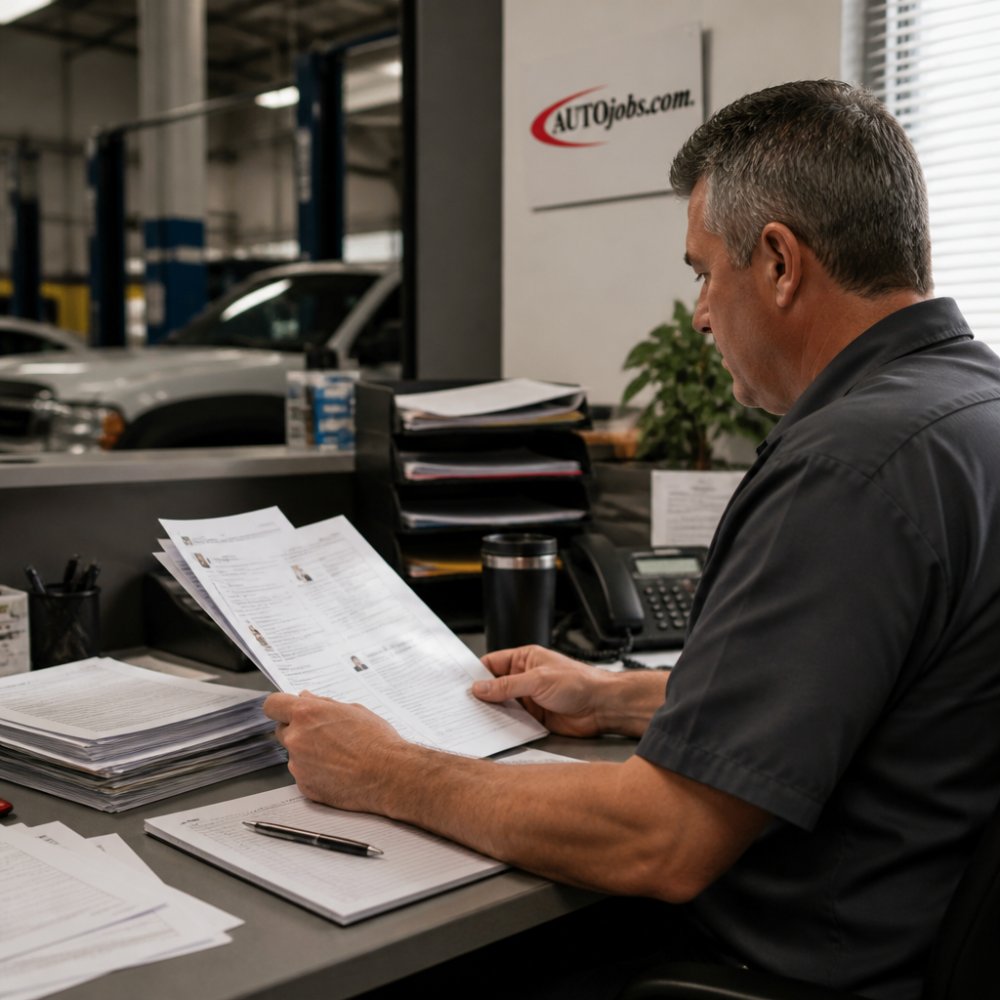
A blended approach also hedges risk. If your job board posting doesn’t generate the right candidates, your agency search continues in parallel.
The cost is higher than using one channel alone, but if you’re filling multiple positions or need speed, the investment can pay for itself in reduced downtime.
Choosing the Right Channel for Your Shop
Generic advice says to pick based on budget and timeline. That’s too coarse to act on. The channel that works depends on the role, the scarcity of the skill, and how much screening you can absorb. Map the role first, then pick the channel.
Role-by-role channel map
Technicians (main line, diesel, collision, EV). These roles are scarce and hands-on, and the best candidates are usually employed and not browsing general boards.
Service advisors and parts counter staff. These roles reward communication and process skill more than deep technical credentials, and the pool is wider.
Fixed operations and service managers. Leadership roles are a networking exercise.
Executive and hard-to-fill roles. When the pool is a dozen people nationwide, an agency or retained search is the tool.
A simple decision tree
- Is the role scarce in your market and credentialed? If yes, an agency or retained search is the fastest route to a shortlist. If no, go to step 2.
- Can you absorb the screening? If you have HR bandwidth or a manager with time, a job board gives you control at lower cost. If not, an agency removes the burden.
- Are you filling one seat or several? One seat favors a job board; several seats in parallel favor a blended approach or an agency.
- Is culture fit decisive for retention? If yes, keep screening in-house where you can, and use the board for reach.
- Is the role leadership-level? If yes, treat it as a search, not a posting.
Avoiding duplicated outreach
The most common blended-strategy mistake is letting an agency and your own posting chase the same candidates. Two recruiters calling the same technician in the same week signals disorganization and can cost you the candidate. Before engaging both, agree on scope: give the agency the hard-to-fill roles, keep the board running for roles you can screen yourself, and tell the agency which postings are live so they don’t duplicate them.
Conclusion
Agencies are worth it when you’re filling specialized automotive roles, need speed, or lack recruiting bandwidth. Job boards work when you have time to screen and want to control the process.
If you’re posting on general job boards and getting unqualified applicants, it’s time to try an automotive-focused approach.
At AUTOjobs.com, we’ve built a platform specifically for automotive hiring because we know the difference quality makes.
Frequently Asked Questions
Is it better to hire through a recruitment agency or a job board?
For automotive dealerships and independent repair shops, an industry-specific job board like AUTOjobs.com often provides a more cost-effective approach to hiring than a recruitment agency or general employment website.
Recruitment agencies can help identify and screen candidates, but their services typically come with substantial placement fees. More importantly, employers are relying on the recruiter’s judgment to determine which candidates deserve consideration. A recruiter may overlook someone who doesn’t meet every requirement on paper but could be an excellent fit after speaking directly with the hiring manager. Employers also have less direct control over the candidate sourcing and selection process.
General employment websites present a different challenge. Because they advertise jobs across virtually every industry, automotive employers often receive applications from individuals with little or no relevant experience. Automated job matching, one-click applications, and AI-generated resumes can further increase the number of poorly matched candidates. Receiving dozens of applications may look impressive, but spending hours reviewing unqualified resumes doesn’t make the hiring process more effective.
AUTOjobs.com takes a different approach. Exclusively serving the automotive industry since 1995, our niche employment website connects dealerships, independent repair shops, collision centers, and other automotive employers with an audience specifically interested in automotive careers.
Employers maintain direct control over their hiring process, receive applications without paying recruiter placement fees, and can search our exclusive Automotive Resume Database. Just as importantly, ongoing job postings help reach experienced automotive professionals who are already employed and may never post a resume but will consider applying when the right opportunity becomes available.
While no employment website can guarantee that every applicant will be qualified, the advantage of AUTOjobs.com is its automotive-focused audience, reduced exposure to unrelated applicants, and direct connection between employers and candidates.
The goal isn’t to generate hundreds of applications or pay a recruiter to decide who deserves an interview. It’s to give automotive employers greater control, better access to relevant candidates, and a more economical way to fill positions with qualified professionals.
What’s the difference between a recruitment agency and a job board?
A recruitment agency acts as a middleman—they source candidates, vet them, and present pre-screened options to you. You pay a fee, typically when someone is hired. A job board is a platform where you post openings and candidates apply directly. You pay a listing fee upfront and do your own screening. Agencies save you time; job boards give you more control and lower entry costs. Automotive staffing agencies specialize in technician and service roles, while general job boards mix automotive jobs with every other industry.
How can employers assess the quality of applicants from a job board?
Quality depends on the job board itself. General job boards attract high-volume, low-relevance applications because they serve all industries—many applicants are using keyword-stuffed resumes or applying to dozens of unrelated roles. Automotive-specific job boards filter candidates by industry focus, so applicants are there for one reason: an automotive career. To assess quality, look at resume specificity (actual shop experience, tool certifications, diagnostics skills), application completion rate, and how many unqualified candidates you’re screening. If you’re wading through dozens of irrelevant resumes, the platform isn’t filtering effectively.
When should an automotive employer use a recruitment agency?
Use a recruitment agency when you need speed, specialization, or relief from screening work. Agencies excel at filling urgent openings, finding hard-to-locate talent (like EV diagnostics specialists), and handling high-volume hiring at large dealership groups. They’re also useful if your HR team is stretched thin. The tradeoff is cost and less control over the candidate pool. For routine hiring at small shops, a job board is often more efficient. For complex roles or time-sensitive needs, an agency’s expertise and network justify the investment.
Can employers use a recruitment agency and a job board at the same time?
Yes, and many do. A blended strategy lets you cast a wider net and compare results. You might post on a job board for general technician roles while working with an agency on a specialized opening like a transmission specialist. This approach spreads risk—if one channel is slow, the other keeps candidates flowing. Track which channel delivers the best hires so you can adjust your mix over time. Just be clear in your job descriptions so candidates don’t apply through both channels for the same role.

